|
Animal House - John Landis (1978) |
HOME | MENU |
A cult movie, a prototype forthe college genre (afterwards they arrived American Pie, Van Wilder, Porky's The College Years and so on) and the first appearance of a nonconformist and brutal character, the student (?) John "Bluto" Blutarsky interpreted by John Belushi, soon after again together with director Jon Landis in Blues Brothers with the very similar character Jakie Blues. The movie starts as a parody of the well known fiction and films about the 50s and 60s years, seen as the "age of innocence" before the 1968 (or the 1963, the year of JFK assassination) as Happy Days or American Graffiti the George Lucas movie of 1973.
The story / Main characters / Soundtrack / Selection of images / Their dult lifei
The story is quite simple and it's based around two "fresher", Pinto (Tom Hulce) and Flounder (the nickname decided by Bluto (Stephen Furst). They have to choice the club, and they started from the good boys' one, Omega it's the name. They are gently invited to remain apart with other unlucky members, and they decided so to try another club, the rival of Omega, the Delta club. A total chaos, strange guys (as Bluto), they are aware that they are going probably to meet several troubles, but it's too much funny, and so they join the Delta.
The remaining of the story is based on the rivality of the two clubs and the actions they invent to defy the "enemy". In this way the other characters are presented: the conscious epicurean Otter (Tim Matheson), the girl of the Delta Katy (Karen Allen) and her boy-friend Boon (Peter Reiter), room mate and accomplice of Otter, the mad biker D-Day (Bruce McGill), Hoover, the president of the Delta Club, the teacher Jennings, interpreted by Donald Sutherland, marijuana smoker and very much interested to Katy, and the rivals, the perfect american boys Neidermeyer and Marmalard and their girls Mandy and Babs, very much appreciated by Bluto and by the other Delta guys.
Delta boys' jokes and transgressions can be read as a reaction to the fifties habits or, more simply, as the consciousness to be the new generation, with new habits and no respect for the old ones. And the perfect representation of the new era is the famous Toga party, no limits, no respect, zero tolerance for the high-minded feelings.
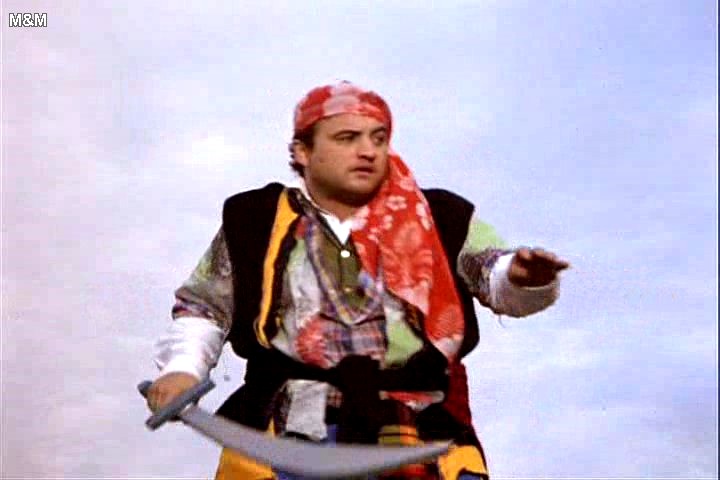
The parade in the town nearby the college is the final apotheosis of the movie, a real battle between the two clubs involving all the population, with Bluto dressed as the pirates and that howls "no prisoners!" and moreover the maximum offense to the spirit of the early sixties, racial integration and other high ideals, the black and white hands separating together (more realistically).
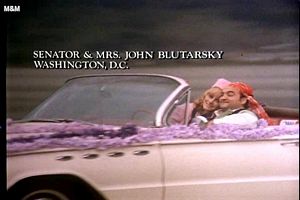
The best gags are the final ones, as in American Graffiti the spectators are informed about the adult life of all these boys and girls, and we learn so how much the real life is full of surprises.
|
Delta Club Guys |
John Belushi : John 'Bluto'
Blutarsky |
|
The adults |
John Vernon : Vernon Wormer (the Dean) |
|
The good guys of the Omega |
James Daughton : Greg Marmalard (Omega president, the "politic man") |
|
The external |
Jessie DeWayne
: Otis Day (R&B singer) |
The soundtrack was curated by the
composer and actor Stephen Bishop and is
organized mainly around R&B songs, at the time (the film action is on 1962)
mostly black music, not the music the large part of white students were usual to
listen to. Between the characters it's even included a fictional R&B singer with
his group, Otis Day and The Knights (Jessie DeWayne, on of the Knights is Robert
Cray, a well known blues singer and guitarist).
The main tune is without doubt
Louie Louie
by the Kingsmen (actually a hit of 1962)
with its "big beat" is a good representation of an era that it's changing. All
the songs are carefully selected, actually available on that November of the
1962.
|
Title |
By |
Some information |
Film's situation |
Animal House / Dream Girl |
Stephen Bishop |
Main theme. Stephen Bishop was also the husband of the main female actor in the movie, Karen Allen |
|
Louie Louie |
The Kingsmen |
A prototype of the garage-band sound and the unique hit for this band from Portland, Oregon. |
The music inside the Delta when Pinto and Flounder ask to Bluto to enter the club, a very different atmosphere in comparison with the Omega, where a classic piano could be heard instead. |
Money (That's What I Want) |
Barrett Strong |
A song that should be famous few years later thanks to the Beatles' cover. Originally it was a R&B on 1961 of the singer Barrett Strong. |
Pinto and Flounder are finally accepted and they can now enter the Delta. |
Hey Paula |
Paul and Paula |
Also in this case a unique hit
for the duo Paul & Paula (real names Ray Hildebrand and Jill Jackson).
They published the song initially as Jill & Ray, and afterwards,
coherently with the lyrics, they decided to change the duo's name in
Paul and Paula). |
Boon and Katy sing together this romantic song under the effect of the joint they smoke at Professor Jenning house. |
Wonderful World |
Sam Cooke |
A very weel known song from a champion of soul music. |
The song in background during the cafeteria episode, it could be actually a "wonderful world", without Bluto ... |
Let's Dance |
Chris Montez |
Chris Montez was a hispanic rocker, as Ritchie Valens, This strong twist style song, was his first hit on 1962, afterwards he followed the composer Herb Alpert towards the easy listening style. |
This famous twist sounds in background, as a dance music, during the inevitable punch-up between the Delta guys leaded by Bluto and the "soldiers" of Neidermeyer following the performances of Bluto in the cafeteria. |
|
Who's Sorry Now |
Connie Francis |
|
|
Twistin' The Night Away |
Sam Cooke |
Anther R&B to be danced from the great Sam Cooke. |
At the Toga party, it's the song that welcomes the persons entering the party. |
| The Cherry Song | Kingston Trio |
A sweet folk ballad, one of the hits of teh Kingston Trio, a famous group of the folk revival (50s . 60s). |
During the Toga party, a well-mannered student (Stephen Bishop himself) is playing this gentle song to a little group of very involved student girls, when Bluto arrives. He is disturbed by this song and by this atmosphere, so much far away from his idea of a funny party. Simply, he smashes the guitar of the guy on the wall giving then to him only this explanation: "Excuse me". Evidently, high-minded feelings and folk music are now the past, and it's not necessary even to explain it. |
Shout |
Isley Brothers |
A minor-hit in the 1959 when the song was published, but in the following years a model for the black music. |
The song performed by Otis Day & The Knights, special guest stars at the Toga Party. |
Shama Lama Ding Dong |
Lloyd Williams |
It should be an original song by Lloyd Williams the actual singer of the song performed by Otis Day (the actor Jessie DeWayne does not sing really) |
Some of Delta boys meet again the Knights and Otis Day during a tour in searching of girls following the tremendous Otter and his tremendous trick. They unfortunately have arrived in a "black-only" nightclub and, despite the racial integration effort, they are not so popular as white young boys. Maybe you can expect that Otis Day should intercede for them, since he knows the whole crew. Not at all, they are pushed out of the pub and, as perfect scoundrels, they leave there her girls. |
Tossin' And Turnin' |
Bobby Lewis |
A blues-soul performer of the early sixties, his unique big hit was this song, published on 1961. |
On the background during the transformation of The Lincoln Continetal, the luxury car of Flounder's brother, in the final weapon for the battle against the Omega guys at the city parade. |
|
Animal House |
Stephen Bishop |
The movie theme, now with lyrics. |
The song in background during film credits. |
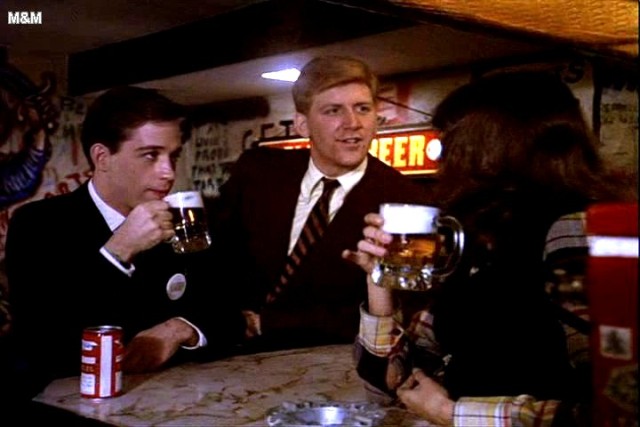
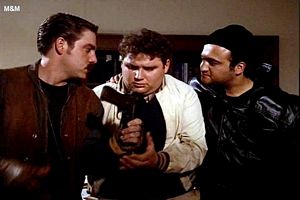
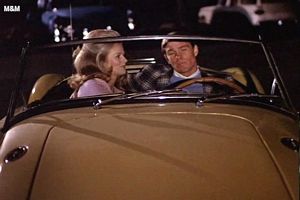
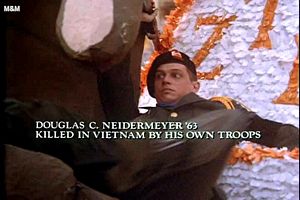
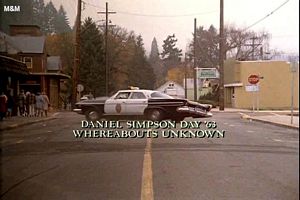
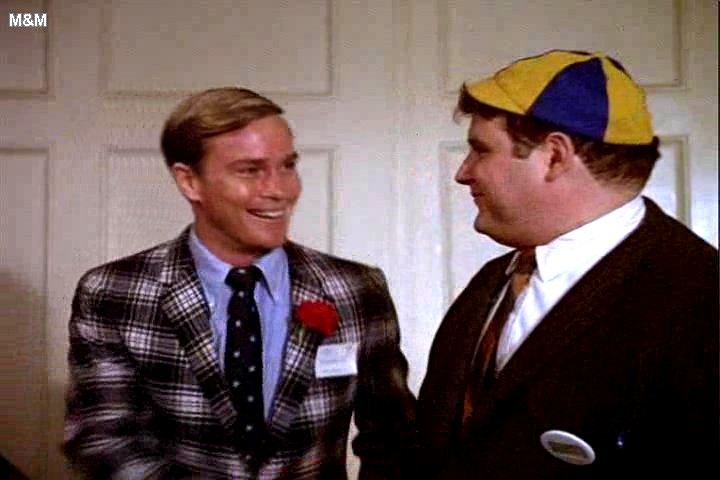
A short selection of images taken by the film Animal House by John Landis.
|
|
Ads by Google |
©
Alberto
Truffi 2010